


A great variety of problems arising in the theory of dynamical
systems may be reduced to the problem whether, for a finite
collection of  matrices
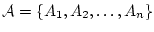 , there exists a bounded invariant set
 with nonempty interior:

 in
in  in which
  for all
 . It is also equivalent to the problem
whether all finite products of matrices
be
uniformly bounded.
. It is also equivalent to the problem
whether all finite products of matrices
be
uniformly bounded.
In the case when  consists of a single matrix,
 , the problem under consideration can be
resolved in terms of the spectrum of the matrix
, the problem under consideration can be
resolved in terms of the spectrum of the matrix  . In general
case, when
. In general
case, when  , the problem is turned out to be more
complicated, and by now different formal supports to this thesis
are known (see, e.g., survey [1]). For example, the problem
on boundedness of infinite products of matrices from a finite set,
equivalent to the problem under consideration, is NP-hard
[1], i.e., algorithmically complex. Alternative
characterization of the complexity of the above formulated problem
is followed from the fact that this problem is algebraically
unsolvable [6] which means, loosely speaking, that it
cannot be resolved by finite Boolean combinations of algebraic
formulae.
, the problem is turned out to be more
complicated, and by now different formal supports to this thesis
are known (see, e.g., survey [1]). For example, the problem
on boundedness of infinite products of matrices from a finite set,
equivalent to the problem under consideration, is NP-hard
[1], i.e., algorithmically complex. Alternative
characterization of the complexity of the above formulated problem
is followed from the fact that this problem is algebraically
unsolvable [6] which means, loosely speaking, that it
cannot be resolved by finite Boolean combinations of algebraic
formulae.
Solutions to finite combinations of algebraic equalities and inequalities form so-called semialgebraic sets with a variety of good (tame) properties which makes them a rather attractive object in mathematical constructions. To isolate the basic properties of semialgebraic sets, in the 80's van den Drie, Knight, Pillay and Steinborn [2,5,7] axiomatically introduce the notion of o-minimal structures and prove that the main bulk of tame properties of semialgebraic sets are inherited by sets definable in o-minimal structures (see., e.g., [3]). Worth to mention that analytical functions (seemingly the most natural candidate to inherit the basic properties of semialgebraic sets) does not form an o-minimal structure nor contained in any o-minimal structure.
Theorem For the problem on
existence of a bounded set with nonempty interior, invariant for
 pieces of matrices, is not definable in o-minimal
structures containing semialgebraic sets.
pieces of matrices, is not definable in o-minimal
structures containing semialgebraic sets.
One of the most broad and useful in practice examples of the
sets, definable in o-minimal structures, is the family
 [4] of all sets which
can be described by finite Boolean combinations of formulae
composing of finite number of algebraic operations, the operation
of exponentiation and application of a finite number of the
restricted analytical functions. Here by restricted analytical
function is meant the function which is equal to an analytical
function on some compact set and to zero outside of it.
[4] of all sets which
can be described by finite Boolean combinations of formulae
composing of finite number of algebraic operations, the operation
of exponentiation and application of a finite number of the
restricted analytical functions. Here by restricted analytical
function is meant the function which is equal to an analytical
function on some compact set and to zero outside of it.
So, the formulated Theorem implies, informally, that the problem on existence of nontrivial bounded invariant set for a family of matrices is unsolvable by finite Boolean combinations of formulae composing of finite number of algebraic operations, the operation of exponentiation and application of a finite number of the restricted analytical functions.
The proof of Theorem is essentially based on two facts: that sets definable in o-minimal structures have only finitely many components of connectedness and that polynomial images of such sets are again sets definable in o-minimal structures (Tarski-Seidenberg principle).